Avinya
The World's First Linen Double Ikat — Created by Varakala Srinivas


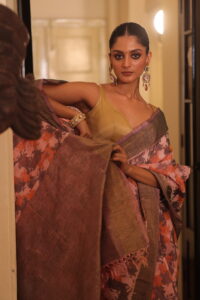
There are textiles that belong to history.
And then there are textiles that attempt to change what history makes possible.
Linen Double Ikat by Varakala Srinivas was born from this second impulse.
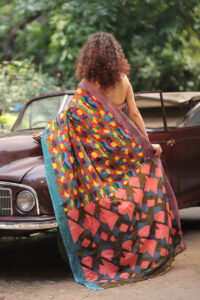
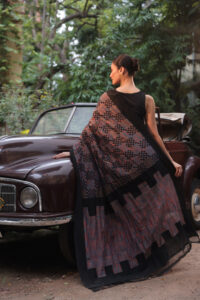
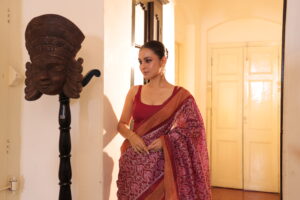
Presented by Varashree as the world’s first Linen Double Ikat, this work brings together two extraordinarily different textile histories: the ancient lineage of linen and the highly complex world of Ikat.
It is an exploration of what happens when one of the oldest textile fibres known to humanity is subjected to one of the most demanding techniques of resist-dyeing.
Linen: A Fibre With Thousands of Years of History
Long before linen became associated with contemporary luxury, flax was already being transformed into textile.
The history of linen reaches deep into human civilisation. Evidence of flax use extends back tens of thousands of years, while flax was domesticated in the Fertile Crescent thousands of years ago. Ancient Egypt subsequently developed linen into an exceptionally important textile tradition.
In ancient Egypt, linen became inseparable from daily life, ceremony and status. It was used for clothing, burial textiles and the wrappings of mummies. Extremely fine linen was produced with remarkable technical skill, and surviving Egyptian textiles demonstrate the sophistication achieved by early linen makers.
From the Mediterranean and West Asia, linen travelled through cultures and economies. Yet despite this extraordinary history, linen developed along a very different path from the great traditions of silk Ikat. That difference became the starting point for this work.
Ikat: A Global Language of Thread
Ikat is not confined to a single country or civilisation. It is a technique that developed and flourished across different parts of the world, particularly throughout Asia, while related traditions also exist in Africa and the Americas. Contemporary museum collections document important Ikat traditions from India, Indonesia, Japan, Uzbekistan, Côte d’Ivoire, Guatemala and many other regions.
Across these cultures, the fundamental principle remains extraordinary: the pattern is created in the yarn before the fabric exists. Threads are selectively bound to prevent dye from penetrating particular areas. After dyeing, the bindings are removed and the process may be repeated for additional colours. The prepared yarns are then woven, revealing the pattern through the alignment of dyed sections.
Ikat therefore demands that the maker imagine the finished textile before it is woven. It is a discipline of anticipation, calculation and precision.
From Ikat to Double Ikat
Among the many forms of Ikat, Double Ikat represents one of its highest levels of complexity. In ordinary warp Ikat, the pattern is created primarily through the warp. In weft Ikat, the pattern is carried by the weft. In Double Ikat, both warp and weft are resist-dyed before weaving.
The two independently prepared systems must then meet with extraordinary precision on the loom. The design is effectively divided between two sets of threads and only becomes fully visible when those threads intersect — making Double Ikat exceptionally demanding in both planning and execution.
India: The Patola Legacy. India occupies a particularly important place in the history of Double Ikat. The Patola of Patan, Gujarat, is among the world's most renowned Double Ikat traditions, requiring the resist-dyeing of both warp and weft and the meticulous alignment of the two during weaving. India also has other important Ikat traditions, including the Double Ikat of Puttapaka in Telangana. For Varakala Srinivas, this history was not a boundary. It was a foundation.
Indonesia and Japan. Indonesia possesses a vast and diverse Ikat heritage, with the celebrated geringsing tradition of Bali being one of the best-known examples of Double Ikat. Japan developed its own sophisticated language of Ikat, known as kasuri, including Double Ikat traditions in the Ryukyu Islands. But there is something striking about all these traditions: silk and cotton dominate the historical vocabulary. And this is where the story of Linen Double Ikat begins.
Why Linen?
The question was deceptively simple: Can Double Ikat be made in linen? Linen is not an easy substitute for silk or cotton — the fibre behaves differently. It has its own structure, strength, stiffness, absorbency and dimensional behaviour. Dyeing and subsequent processing can alter the material, making the precise control required for Double Ikat even more demanding.
Double Ikat already requires the exact relationship between thousands of dyed warp and weft threads. Introducing linen creates another variable: the behaviour of the fibre itself. Every calculation therefore becomes a negotiation between geometry and material.
The Challenge. To create Double Ikat, the maker must think simultaneously as a designer, dyer, mathematician and weaver. The design must first be translated into calculations, transferred onto the yarn, tied and resist-dyed accordingly. Both warp and weft must undergo their respective preparations, and finally meet on the loom with sufficient accuracy for the intended image to emerge. With linen, the challenge becomes even more demanding — the material cannot simply be treated like silk. It has to be understood on its own terms.
The Breakthrough
It was through this process that Varakala Srinivas pursued the possibility of creating Double Ikat in linen. The objective was not to imitate Patola. It was not to reproduce an Indonesian or Japanese tradition. It was not to simply transfer an existing Ikat design onto another fibre.
The objective was more fundamental: to discover whether linen could enter the world of Double Ikat on its own terms. The resulting work is presented by Varashree as The World’s First Linen Double Ikat — a meeting of an ancient fibre and an exceptionally demanding textile technique.
Linen carries the memory of some of humanity's earliest textile cultures. Ikat carries the accumulated knowledge of generations of artisans across continents. Double Ikat represents one of the most technically demanding expressions of that tradition. Bringing them together creates a conversation between two histories that developed largely along separate paths.
For Varakala Srinivas, the question was: «What happens when the complexity of Double Ikat meets the character of linen?» The answer is this work — a textile developed through experimentation, calculation, craftsmanship and persistence.
A New Chapter
For Varashree, innovation does not mean abandoning tradition. It means entering tradition deeply enough to understand where it can be taken next. Linen Double Ikat is therefore both an homage and an intervention — an homage to the generations who developed the extraordinary knowledge of Ikat, and an intervention into what materials can be considered within its most complex expressions.
It is a proposition to the textile world: that an ancient fibre can still create a new frontier. From the ancient flax fields of civilisation to the resist-dyed threads of the Ikat tradition, from the Double Ikat masters of India, Indonesia and Japan to a new experiment in linen — this work represents a journey across time, geography and technique.
Linen Double Ikat. A new chapter in the world of Ikat.
Created by Varakala Srinivas
The collection, in full.
Explore Avinya